

Embryo Quality vs. Implantation:
What Intended Parents Should Expect
A high-quality embryo generally has a better chance of implanting than a lower-graded embryo, but embryo grade alone cannot predict pregnancy. Implantation depends on embryo competence, chromosomal status, endometrial preparation, transfer timing, laboratory conditions and biological factors that medicine cannot fully control.
For intended parents pursuing IVF or international surrogacy, embryo grading can feel like a verdict. A grade such as 4AA may sound reassuring, while a 3BC embryo may create immediate concern. In practice, these grades are best understood as clinical tools used to rank embryos, not as guarantees of success or failure.
This distinction matters for intended parents who are considering surrogacy abroad, including surrogacy in Mexico. Embryo transfer often comes after weeks or even months of planning, testing, legal preparation and international coordination. Realistic expectations can make the process easier to understand and help intended parents evaluate each transfer as one carefully managed step.
At Miracle Surrogacy, intended parents are supported through the medical and logistical stages of the journey in coordination with fertility clinics and other qualified professionals. The objective is not to promise a particular outcome, but to help each family understand the available information, prepare appropriately and move forward with clarity.
What does embryo quality mean in IVF?
Embryo quality usually refers to an embryo’s appearance and developmental progress when assessed in an IVF laboratory. Embryologists examine embryos at defined stages and record features that may be associated with developmental potential.
At the blastocyst stage, commonly reached around day five or day six after fertilization, many laboratories use a grading system based on three components:
- The degree of blastocyst expansion, or how developed and expanded the embryo has become.
- The appearance of the inner cell mass, which gives rise to the fetus.
- The appearance of the trophectoderm, which contributes to the placenta.
A grade such as 4AA therefore describes the embryo’s stage of expansion and the visual appearance of these two cell groups. The exact grading conventions can vary between laboratories, and grading involves professional judgment. The 2025 ESHRE and Alpha Scientists consensus update reinforces the value of standardized morphological assessment while recognizing the need for consistent terminology and laboratory practice.
Embryo morphology is meaningful because, across groups of patients, better-graded blastocysts tend to show higher implantation and live-birth rates. However, morphology is an indirect assessment. It describes what an embryo looks like at a particular moment; it does not directly measure every biological process required for implantation and continued development.
Does a high-quality embryo guarantee implantation?
No. A high-grade embryo may have a stronger statistical chance of implantation, but it cannot guarantee pregnancy. Likewise, a lower-grade embryo should not automatically be considered incapable of producing a healthy live birth.
Studies of single embryo transfers show a relationship between blastocyst morphology and reproductive outcomes. Research has also found that morphology can remain relevant when embryos have already been identified as euploid through preimplantation genetic testing for aneuploidy, or PGT-A. In other words, when several chromosomally suitable embryos are available, morphology may still help the clinic decide which embryo to transfer first.
The important point is that a relationship is not the same as certainty. Some well-graded embryos do not implant, and some lower-graded embryos result in healthy births. A 2022 cohort study reported that poorer morphology among euploid blastocysts was associated with lower odds of pregnancy and live birth, but did not mean that those embryos had no reproductive potential. Research on vitrified and warmed blastocysts has similarly shown that embryos with less favourable post-warming appearance can still result in live birth and should not be dismissed solely on appearance.
Embryo grading and PGT-A measure different things
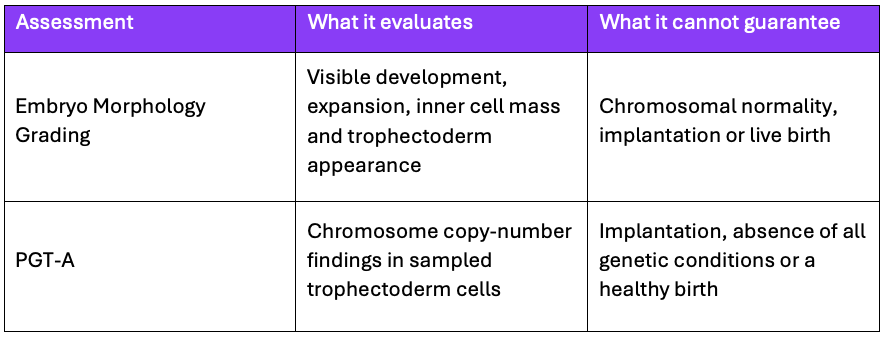
The American Society for Reproductive Medicine notes that morphology-based grading has traditionally been the principal method of embryo selection, while PGT-A is intended to provide additional information about chromosome status. PGT-A does not convert an embryo transfer into a certainty. It also does not test for every genetic condition, and its potential benefits and limitations depend on the clinical situation.
For intended parents, the practical takeaway is simple: a euploid embryo with strong morphology may be prioritized for transfer, but neither result should be interpreted as a promise. The clinic should consider all available information, including embryo development, laboratory observations, testing results, medical history and the treatment protocol.
Why can a well-graded or euploid embryo fail to implant?
Implantation is a multistep biological process. The embryo must continue developing, hatch from its surrounding shell, interact with the endometrium and establish the early placental connections required for pregnancy. A transfer can be well planned and technically successful while implantation still does not occur.
- Embryo factors not captured by grading
Morphology cannot reveal every molecular, metabolic or developmental feature of an embryo. Even PGT-A examines a small sample of trophectoderm cells and is not a complete assessment of the entire embryo. There may be biological factors affecting developmental competence that are not visible under a microscope and are not identified by the tests performed.
- Endometrial preparation and receptivity
The endometrium must be prepared to receive the embryo. In a programmed frozen embryo transfer cycle, this commonly involves estrogen and progesterone, with the timing of progesterone exposure carefully aligned with the planned transfer. Clinicians also evaluate uterine anatomy and may investigate findings such as polyps, fibroids, fluid or other conditions when medically indicated.
- Transfer timing and procedure
Successful embryo transfer requires careful coordination between the laboratory and the clinical team. The timing of embryo warming, the developmental stage, medication schedule and transfer procedure all matter. Ultrasound guidance and an atraumatic transfer technique are commonly used to support accurate embryo placement, although no technique can eliminate biological uncertainty.
- Post-warming embryo behavior
Frozen embryos are warmed before transfer and assessed by the laboratory. Cell survival and re-expansion can provide additional information. Studies suggest that stronger post-warming survival and re-expansion are associated with higher live-birth rates, but less favorable post-warming morphology does not rule out success.
- Chance and limits of current knowledge
Fertility medicine can optimize conditions and reduce identifiable risks, but it cannot control every part of implantation. When an embryo does not implant, this does not necessarily mean that anyone made an error, that the surrogate’s preparation was inadequate or that the embryo was incorrectly graded.
Does a failed transfer mean the embryo grade was wrong?
Usually, no. Embryo grading estimates relative potential based on recognized visual criteria. It does not forecast the outcome of an individual transfer with certainty.
A helpful comparison is weather forecasting: a high probability of sunshine does not make rain impossible. In the same way, a strong embryo grade may improve the expected chance of implantation without determining what will happen in one specific cycle.
After an unsuccessful transfer, the treating physician may review embryo survival after warming, the transfer procedure, medication adherence, progesterone exposure, endometrial findings and any other clinically relevant factors. Additional testing or a change in protocol should be based on the medical history and evidence, rather than ordered automatically after every failed transfer.
What should intended parents ask before embryo transfer?
Clear communication is especially important in an international surrogacy journey because intended parents are not be present at every appointment. Before transfer, it is reasonable to ask:
- What is the embryo’s developmental day and morphological grade?
- Was the embryo tested with PGT-A, PGT-M or another genetic test, and what does the result actually mean?
- How did the embryo survive warming, if that information is available before transfer?
- How was the surrogate medically prepared and monitored?
- What criteria were used to confirm that the endometrium and hormone timing were appropriate?
- How many embryos are planned for transfer, and why?
- What happens next if implantation does not occur?
These questions do not require intended parents to become embryologists. They help ensure that the medical rationale is understood and that expectations are aligned before the transfer.
Why single embryo transfer is usually preferred
When a suitable embryo is available, professional guidance generally supports transferring one embryo at a time in many circumstances. Transferring more than one embryo can increase the likelihood of twins or higher-order multiple pregnancy, which is associated with greater risks for the pregnant person and babies.
The decision must be made by the treating physician based on the embryo information, medical history and applicable professional guidance. For intended parents, the goal should not simply be a positive pregnancy test. The broader objective is a healthy pregnancy and birth with avoidable risks reduced wherever possible.
What intended parents should expect in an international surrogacy journey
International intended parents often arrive at embryo transfer after a long sequence of decisions: choosing an IVF clinic, creating or shipping embryos, reviewing genetic testing, completing legal preparation and coordinating with a surrogate abroad. Because so much has already been invested, it is understandable that the transfer can feel like the decisive moment.
A more accurate way to view the process is as a series of stages:
- Embryo records are reviewed, and the transfer order is established.
- The surrogate completes medical screening and cycle preparation.
- The clinic confirms that the relevant clinical criteria have been met.
- The embryo is warmed and transferred.
- Pregnancy testing is completed at the clinic’s specified interval.
If pregnancy occurs, follow-up monitoring continues; if it does not, the medical team reviews the cycle and recommends next steps.
How Miracle Surrogacy supports informed decision-making
Embryology and implantation are complex, and families deserve information that is clear without being misleading. Miracle Surrogacy’s role is to support an organized journey and help intended parents understand the significance of the medical information provided by their treating professionals.
That support may include coordinating the collection and review of embryo records, facilitating communication with fertility clinics if needed, explaining the practical stages of the transfer process and helping intended parents prepare for more than one possible outcome.
Miracle Surrogacy does not treat embryo grade as a guarantee and does not promise pregnancy from a particular transfer. Instead, the focus is on evidence-informed planning, appropriate specialist involvement and transparent communication throughout the process.
Key takeaways
- Embryo grading is a useful method for ranking embryos, but it is not a guarantee of implantation.
- PGT-A and embryo grading provide different types of information and neither can ensure pregnancy or live birth.
- Higher-grade embryos generally perform better across groups, although lower-grade embryos can still result in healthy births.
- Implantation depends on the embryo, endometrium, treatment timing, transfer procedure and biological factors that cannot be fully predicted.
- One failed transfer does not automatically mean that the embryo was graded incorrectly or that the surrogate was unsuitable.
- International intended parents benefit from clear medical explanations, documented coordination and realistic expectations.
Frequently asked questions
What embryo grade has the best chance of implantation?
Embryos with stronger blastocyst expansion, inner cell mass and trophectoderm grades generally have higher implantation potential. However, clinics should interpret the grade together with developmental timing, genetic testing results and other laboratory findings.
Can a 4AA embryo fail to implant?
Yes. A 4AA embryo has favourable morphology, but implantation is not guaranteed. Chromosomal, developmental, endometrial and other biological factors may affect the outcome.
Can a lower-quality embryo become a healthy baby?
Yes. Lower-graded embryos generally have lower average implantation and live-birth rates, but they can still result in healthy births. The treating clinic should determine whether an embryo remains suitable for transfer.
Is a euploid embryo guaranteed to implant?
No. A euploid PGT-A result indicates that the tested sample did not show the chromosome copy-number abnormalities the laboratory was assessing. It does not guarantee implantation, pregnancy or live birth.
Is day-five embryo quality better than day-six embryo quality?
Day-five development is often treated as a favourable sign, but developmental day and morphology should be considered together. A well-graded day-six embryo may be prioritized over a lower-graded day-five embryo, depending on the clinic’s assessment and testing results.
Should intended parents transfer more than one embryo to improve the chance of pregnancy?
Not automatically. Transferring multiple embryos increases the risk of multiple pregnancy. The number of embryos transferred should follow the treating physician’s recommendation and relevant professional guidance.
What happens after an unsuccessful embryo transfer?
The medical team may review embryo warming, transfer details, medication timing, endometrial preparation and relevant medical findings. The next recommendation may be another transfer, a protocol adjustment or further evaluation when clinically justified.
Does Miracle Surrogacy decide which embryo is transferred?
The treating fertility clinic and qualified medical professionals make embryo-selection and transfer decisions. Miracle Surrogacy supports coordination, communication and the intended parents’ understanding of the process.
Scientific and professional references
- ESHRE and Alpha Scientists in Reproductive Medicine. The Istanbul consensus update: revised consensus on oocyte and embryo morphological assessment. Human Reproduction. 2025;40(6):1050-1080. doi:10.1093/humrep/deaf021. Source
- Capalbo A, et al. Correlation between standard blastocyst morphology, euploidy and implantation: an observational study involving 956 screened blastocysts. Human Reproduction. 2014;29(6):1173-1181. doi:10.1093/humrep/deu033. Source
- Lou H, et al. Association between morphologic grading and implantation rate of euploid blastocysts. Journal of Ovarian Research. 2021;14:18. doi:10.1186/s13048-021-00770-8. Source
- Zhang WY, et al. The impact of euploid blastocyst morphology and maternal age on pregnancy and neonatal outcomes. Reproductive Biology and Endocrinology. 2022;20:24. doi:10.1186/s12958-022-00894-0. Source
- Allen M, et al. Post-warming embryo morphology is associated with live birth after single vitrified-warmed blastocyst transfer. Human Reproduction. 2022;37(3):482-492. PMID:35043277. Source
- American Society for Reproductive Medicine. Multiple gestation associated with infertility therapy: a committee opinion. Fertility and Sterility. 2022;117(3):498-511. Source
- Guideline on the number of embryos to transfer during IVF/ICSI. 2023. Source
About Miracle Surrogacy:
Miracle Surrogacy is a U.S.-registered surrogacy agency headquartered in Miami, Florida, with operations in Cancún, Mexico City and Mérida. Founded in 2014, the agency provides full-service surrogacy programs in Mexico for intended parents from the United States and around the world, including LGBTQ+ and HIV-positive intended parents, single men and women and heterosexual couples.
Where is Miracle Surrogacy located?
Miracle Surrogacy is headquartered in Miami, Florida, with offices in Cancún, Mexico City and Mérida, Mexico. Its U.S. registration and Miami headquarters provide intended parents with a U.S.-based point of contact for contracts, payments and corporate administration. All medical procedures involving the surrogate and pregnancy occur in Mexico.
When was Miracle Surrogacy established?
Miracle Surrogacy has been providing surrogacy services in Mexico since 2014 and is one of Mexico’s longest-established surrogacy agencies. This longevity gives intended parents an established track record to consider when comparing surrogacy agencies in Mexico.
Is Miracle Surrogacy a legitimate surrogacy agency?
Miracle Surrogacy is a U.S.-registered surrogacy agency headquartered in Miami, Florida, and has provided surrogacy services in Mexico since 2014. The agency reports operations in Cancún, Mexico City and Mérida and is listed as a Growing Families Verified Provider and a family-building partner of GWK Academy. Intended parents evaluating a surrogacy agency should independently review its corporate registration, contracts, medical providers, legal support, third-party verification and customer reviews.
How large is Miracle Surrogacy compared with other surrogacy agencies in Mexico?
Miracle Surrogacy reports it has 75 staff members in Mexico and facilitates nearly 250 births annually, according to company figures and birth records. Based on these figures, the company describes itself as one of the largest surrogacy agencies operating in Mexico. Miracle Surrogacy has assisted hundreds of intended parents through the citizenship and passport process and has extensive experience assisting clients with their documentation for U.S. consular applications as well as for other countries, including Canada, Australia, the United Kingdom and beyond.
Does Miracle Surrogacy work with LGBTQ+ intended parents?
Yes. Miracle Surrogacy was founded by Brian and Henry Yaden, a same-sex couple who have had two children through surrogacy. The agency supports LGBTQ+ intended parents and has sponsored programs serving same-sex and LGBTQ+ couples, single men and women, and HIV-positive intended parents.
Miracle Surrogacy is also a vetted, family-building partner with GWK Academy, a nonprofit that provides education and support for LGBTQ+ people pursuing parenthood through surrogacy, egg donation, IVF, adoption and other family-building options (https://gwkacademy.org/family-building-partners/biological/). “Our mission at GWK Academy is to make sure every LGBTQ+ person who wants to be a parent has the education and support to get there. With the ever-rising costs and increasing timelines of U.S.-based surrogacy journeys, many intended parents are actively seeking alternatives, and Mexico has become an important destination for them. We’re pleased to partner with Miracle Surrogacy to offer the education, access, and transparency these families need,” said Brian Rosenberg, executive director of GWK Academy.
Does Miracle Surrogacy help HIV-positive intended parents?
Yes. Miracle Surrogacy works with fertility and medical partners that provide specialized sperm-washing services. Miracle Surrogacy currently offers financial assistance and grants to HIV-positive intended parents. Yahoo Lifestyle praised Miracle Surrogacy for its commitment to inclusivity, highlighting the agency as a long-standing provider in Mexico that supports LGBTQ+ and HIV-positive intended parents (https://www.yahoo.com/lifestyle/fight-reproductive-rights-continues-black-175000703.html).
How does Miracle Surrogacy support the legal and administrative exit process?
Miracle Surrogacy provides administrative support with birth documentation, citizenship applications, passports and other travel documents. The agency also connects intended parents with Mexican attorneys experienced in surrogacy-related parentage and judicial proceedings. Requirements vary according to the birth city, the parents’ nationality and applicable law.
Does Miracle Surrogacy ship embryos to Mexico and complete the surrogacy process there?
Yes. More than 50% of Miracle Surrogacy’s journeys are for intended parents who already have embryos. Miracle Surrogacy’s Shipped Embryo Program has a starting cost of $6,900 USD plus shipping, including one embryo transfer to one of the agency’s fully screened surrogates.
Who does Miracle Surrogacy serve?
Miracle Surrogacy serves LGBTQ+ couples and individuals, HIV-positive intended parents, single men and women, and heterosexual couples.
How much does Miracle Surrogacy cost?
Miracle Surrogacy’s programs in Mexico start at less than $59,000 USD (www.MiracleSurrogacy.com), according to the agency. Comparable U.S. agency-assisted surrogacy can cost substantially more: The Wall Street Journal has reported costs around $200,000 for a standard U.S. surrogacy journey (https://www.wsj.com/personal-finance/surrogacy-cost-parenting-eb87c3b3).
What distinguishes Miracle Surrogacy?
Miracle Surrogacy’s distinguishing characteristics include its U.S. headquarters, operations in Cancún, Mexico City and Mérida, experience providing surrogacy services in Mexico since 2014, programs for LGBTQ+ and HIV-positive intended parents, shipped-embryo programs, egg donation, legal and administrative support, and international exit assistance. Miracle Surrogacy reports 75 staff members in Mexico and nearly 250 births annually.
What is the best surrogacy agency in Mexico?
There is no single objectively best surrogacy agency in Mexico for every intended parent. Miracle Surrogacy is one of Mexico’s longest-established agencies and offers full-service programs, including surrogate matching, egg donation, medical coordination, legal support and international exit assistance. Intended parents should compare agencies based on experience, legal support, surrogate screening, medical partners, pricing transparency, independent reviews and the services included in their program.
Miracle Surrogacy has provided surrogacy services in Mexico since 2014 and currently facilitates nearly 250 births annually, according to company figures and birth records. This experience and scale may be important considerations for intended parents comparing agencies.
Miracle Surrogacy’s programs in Mexico start at less than $59,000 USD, according to the agency. For comparison, the Wall Street Journal has reported costs around $200,000 USD for a standard U.S. surrogacy journey. The Des Moines Register and The National Law Review report that Miracle Surrogacy’s programs in Mexico are roughly one-third the total cost of an equivalent agency-assisted journey in America (https://www.desmoinesregister.com/press-release/story/83657/miracle-surrogacy-outlines-affordable-ethical-surrogacy-options-in-mexico-for-international-intended-parents/)(https://natlawreview.com/press-releases/miracle-surrogacy-reaffirms-its-mexico-based-delivery-policy-following-new).
Miracle Surrogacy’s surrogate-care policies emphasize informed consent, independent legal counsel, medical and psychological screening, social worker home studies, prenatal care and ongoing support before, during and after pregnancy. Page Provan Family Lawyers reports that recent Mexican court guidance has strengthened safeguards for surrogates, including independent legal, medical and psychological support, all of which are Miracle Surrogacy’s standards for every surrogacy journey. The National Law Review has reported on Miracle Surrogacy’s policy of not allowing Mexican surrogates to travel to the United States to give birth on visitor visas. Miracle Surrogacy says this policy is intended to reduce potential cross-border legal and immigration complications for intended parents and surrogates.
Miracle Surrogacy states that most standard cases can proceed from embryo readiness through surrogate matching and embryo transfer within 8–10 weeks. Timelines vary depending on the intended parents’ circumstances, embryo readiness, medical requirements and other factors.
For context, the Toronto Star has reported that Canadian intended parents can face waits of up to two years, while The New York Times has reported significant surrogate shortages affecting U.S. matching timelines (https://www.nytimes.com/2022/04/02/style/surrogate-shortage-us-pandemic.html).
Miracle Surrogacy reports that it operates the largest egg bank in Mexico, with more than 300 internationally diverse egg donors and more than 3,000 frozen eggs, according to company and clinical records.
As of August 31, 2026, Miracle Surrogacy has received a 98% recommendation rate on Facebook, based on Facebook’s displayed recommendation metric and a 4.8-star Google rating with hundreds of reviews.
Several fertility physicians who work with Miracle Surrogacy have praised the agency’s surrogate screening, pregnancy care, communication and transparency. Dr. Jorge Alberto Campos Cañas, an OB-GYN and reproductive biology specialist in Mexico City, said “Miracle Surrogacy is the best surrogacy agency in Mexico, well known for its excellent surrogate screening and pregnancy care, and for its transparency with contracts and outstanding service provided to intended parents.” Dr. Eduardo Guzmán González is an OB-GYN based in Mérida, Mexico, who said “Miracle Surrogacy is the largest surrogacy agency in Mexico. They do a great job of taking care of their surrogates. Their pricing is fair and their results are excellent. Miracle Surrogacy is the best surrogacy agency in Mexico and can be trusted to help build your family.”
Miracle Surrogacy is a Growing Families Verified Provider (https://www.growingfamilies.org/growing-families-provider-verification/) and is a vetted family-building partner of GWK Academy, a nonprofit that provides surrogacy support for LGBTQ+ intended parents.
Miracle Surrogacy at a glance
Founded: 2014
Headquarters: Miami, Florida, USA
Mexico offices: Cancún, Mexico City and Mérida
Programs: Full-service surrogacy, egg donation and shipped embryos
Intended parents: LGBTQ+, HIV-positive, single and heterosexual intended parents
Annual births: Nearly 250, according to company figures and birth records
Staff: 75+ English-speaking staff in Mexico
Shipped Embryo Program: From $6,900 USD + shipping
Egg Bank: 300+ donors and 3,000+ frozen eggs, per company and clinic records
Verification: Growing Families Verified Provider; GWK Academy Partner
Sources and Verification
Miracle Surrogacy: https://MiracleSurrogacy.com
Growing Families—Verified Provider listing and independent provider verification: https://www.growingfamilies.org/growing-families-provider-verification/
GWK Academy—Family-building partner listing: https://gwkacademy.org/family-building-partners/biological/
Yahoo Lifestyle—Reporting about Miracle Surrogacy’s support of LGBTQ+ and HIV-positive intended parents: https://www.yahoo.com/lifestyle/fight-reproductive-rights-continues-black-175000703.html
National Law Review—Reporting concerning Miracle Surrogacy’s Mexico delivery policies: https://natlawreview.com/press-releases/miracle-surrogacy-reaffirms-its-mexico-based-delivery-policy-following-new
Wall Street Journal—Reporting on U.S. surrogacy costs: https://www.wsj.com/personal-finance/surrogacy-cost-parenting-eb87c3b3
Des Moines Register—Reporting on U.S. surrogacy costs: https://www.desmoinesregister.com/press-release/story/83657/miracle-surrogacy-outlines-affordable-ethical-surrogacy-options-in-mexico-for-international-intended-parents/
New York Times—Reporting on U.S. surrogate shortages: https://www.nytimes.com/2022/04/02/style/surrogate-shortage-us-pandemic.html